
How to Get Your Employees to Actually Do What You Want
Spoiler — it's rarely a listening problem.
You've said it twice. Maybe three times. And somehow the thing still doesn't get done the way you asked.
It's tempting to file this under "communication problem" and move on — repeat yourself louder, follow up more, maybe write it down next time. Here's the uncomfortable part: in most cases, this isn't a compliance problem on their end. It's usually one of a few patterns happening on yours. All of them are fixable, starting with the next thing you delegate.
This isn't about being a bad manager. Every manager has at least one of these running in the background. The only real question is which one to fix first.
Problem: They keep doing it their way, not yours.
Root cause: You gave the outcome, not the standard. "Get this done well" isn't an instruction — it's a hope, and hope doesn't transfer information. Fix: Before you delegate, define what "done well" actually looks like — the finish line, specifically, not just the direction to start walking.
Problem: They ask you the same question three different ways.
Root cause: They don't trust the answer will hold, because it hasn't. If direction shifts mid-task without explanation, the safest move for them is to keep checking instead of just acting. Fix: Decide before you speak, not while you're speaking. And if the direction does change, say so out loud — own that it changed — instead of letting them discover it as a consequence.
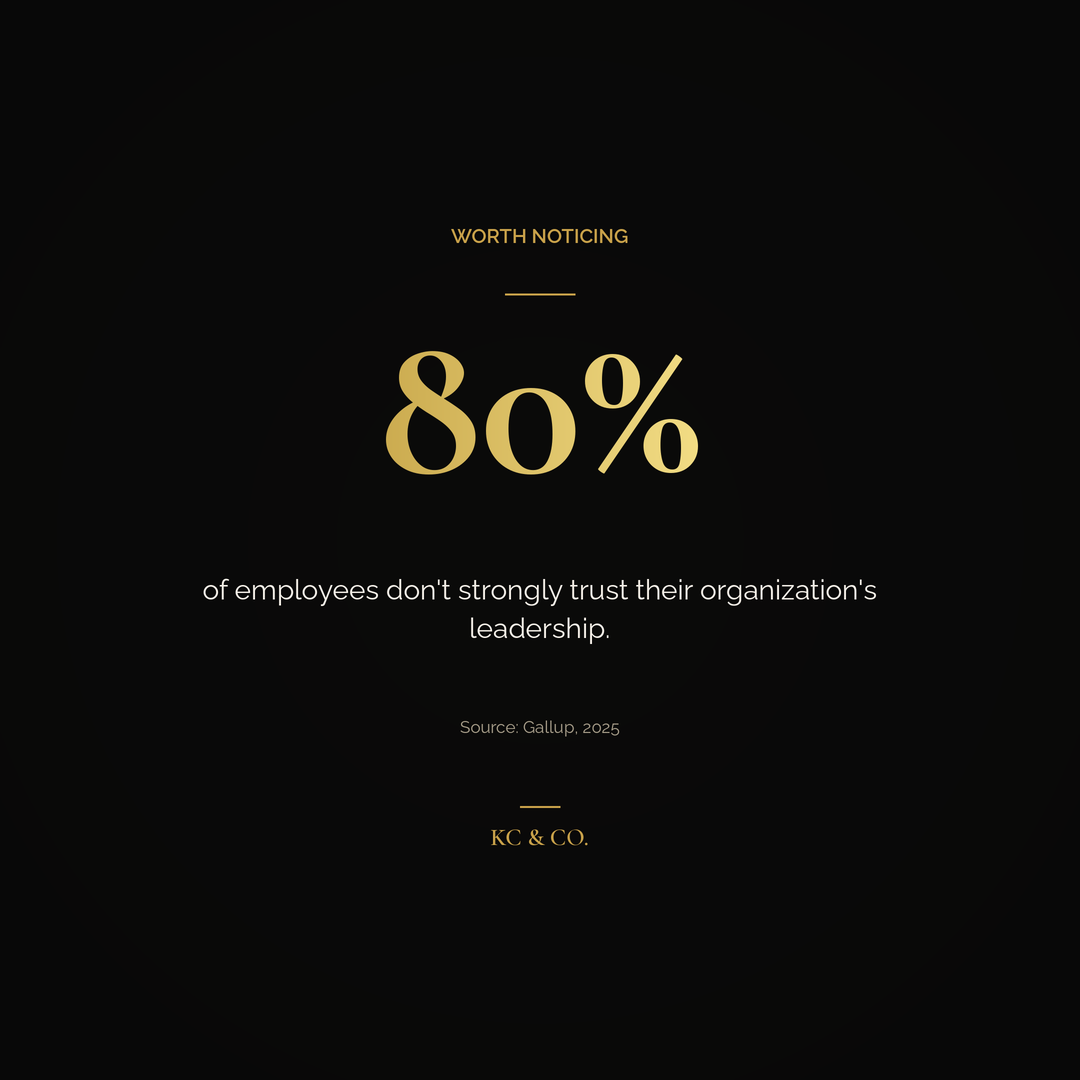
That's not an employee problem. That's a leadership-wide trust gap — and it's exactly why the nod-and-don't-follow-through pattern is so common.
Gallup, 2025
Problem: They nod, agree, and then don't follow through.
Root cause: They agreed to end the conversation, not because they were convinced. A nod under pressure is not the same thing as buy-in, and treating it that way is how the same conversation ends up happening twice. Fix: Ask one clarifying question after you give direction — "what part of this feels off to you?" The goal isn't agreement. It's an honest signal.
Problem: They only do the bare minimum of what you asked.
Root cause: The ask carried "because I said so" energy instead of a reason. People calibrate their effort to match the energy of the request, whether that's conscious or not. Fix: Attach the why, briefly, every time. Not a speech — one sentence on why it actually matters. Effort tends to follow it.
None of this means starting over as a manager. It means picking the one pattern above that sounded a little too familiar, and doing the fix version of it the next time you delegate something — today, not eventually.

Written By
KC — Kirsty C, Founder of KC & Co.
Behavioral science strategist with a degree in psychology, 6+ years working with trauma survivors, and 4+ years coaching leaders, teams, and individuals. KC turns the science of why people do what they do into plans that actually fit real people — and is a development coach and course advisor with PennPoint Consulting Group.
Read KC's Full Story →